The complete course
Genesis 1–11, verse by verse, in twelve weeks.
The same four techniques from Lesson Zero, now applied to the whole book — every chapter, from the first bərēʾšît to the last name in Babel, with the counting, the grammar, the lexicon and the scholarly debate behind the text you've already read a hundred times.
Study PDF · Português, English, Español · 7-day guarantee
28
Letters in the seven words of verse 1
בְּרֵאשִׁית
Genesis 1:1 — seven words, twenty-eight letters. Seven times four isn't an accident: it's the Bible's first sentence teaching how Hebrew uses number to say "complete."
Four facts checked against the Masoretic Text — one from each stretch of the course.
The problem
You've already read all of Genesis. That's not what's missing.
What's missing isn't familiarity with the story — it's the instrument to see what the text is doing underneath it. Lesson Zero showed that in two lines. This course shows it in eleven whole chapters: each with its own numerical patterns, its own grammar the translation had to simplify, its own vocabulary chosen on purpose, and its own points of disagreement among serious readers of the text.
Reading too fast is the most common way to never see this. Twelve weeks isn't the time it takes to read Genesis 1–11 — you can read it in twenty minutes. It's the time it takes to stop at each chapter long enough to count, compare and argue with the text itself before moving on.
The method
The four techniques, now in each of the eleven chapters.
You already know all four if you did Lesson Zero. The difference here: they repeat, week after week, until they become reflex — and each application uses a different number, word or debate, never the same recycled example.
TÉCNICA 1
Counting the structure
Numerical patterns, repetitions and symmetries carry the theme. When Hebrew repeats a word seven times, or twenty-one, that isn't style — it's the structure saying something the translation can't underline.
Week 8, Genesis 7: mayim (waters) appears nine times, concentrated in 7:17-24 — exactly where the text narrates the flood prevailing.
TÉCNICA 2
Hunting the invisible grammar
What the translation had to drop: a verb form, a sound pun, an ambiguity English doesn't hold. You learn to sense where a gap exists, even without reading Hebrew.
Week 4, Genesis 3: ʿārōm (naked, in 2:25) and ʿārûm (crafty, in 3:1) sound almost identical and frame the chapter break — a pun no translation carries.
TÉCNICA 3
Comparing the lexicon
Why this word and not the one next to it. Hebrew had alternatives; the one chosen carries an intention the synonym wouldn't have — and comparing the two is how that intention shows up.
Week 9, Genesis 8: yônāh (dove) appears five times, all between 8:8 and 8:12 — the raven, sent out earlier, is never mentioned again.
TÉCNICA 4
Mapping the debate
Knowing where scholars disagree is worth more than memorizing one side. You stop repeating the only reading you've heard and start seeing the whole field of discussion.
Week 7, Genesis 6: who are the "sons of God" in 6:2 — three competing readings, each with its own textual argument, with no answer the whole tradition accepts.
The full journey
Genesis 1–11, week by week
Tap any week to see the theme and one real fact, checked against the Hebrew text — not a generic chapter summary.
01 Genesis 1:1-2 The prologue: primordial chaos
The Bible's first sentence, word by word — the same ground as Lesson Zero, but deeper: the seven words, the twenty-eight letters, and what תֹהוּ וָבֹהוּ carries that no translation can.
Fact checked in Hebrew
bərēʾšît bārāʾ ʾĕlōhîm — seven words, twenty-eight letters: seven times four. The Bible's first sentence already teaches how to count.
02 Genesis 1:3-31 The symphony of the six days
The six days aren't just narrative — they're architecture. The patterns Umberto Cassuto catalogued, the refrain "and God saw that it was good" repeated seven times, the ten "and God said" that structure the whole chapter.
Fact checked in Hebrew
ṭôb (good) appears seven times across the six days — and wayyōʾmer ʾĕlōhîm (and God said) appears nine exact times — the tenth utterance, in 1:28, has a word in between.
03 Genesis 2 The garden of Eden
The second creation account, focused on the human being: the garden, the rivers, the forming of the woman, and why Hebrew uses two different words for "create" in the first two chapters — signed with a compound name for God that almost never appears outside these chapters.
Fact checked in Hebrew
The pair YHWH ʾĕlōhîm (LORD God) appears eleven times in Genesis 2 — and twenty times across chapters 2 and 3 together. Outside that, the compound name nearly vanishes from the rest of the Pentateuch.
04 Genesis 3 The Fall
The pun at the chapter break — ʿārōm (naked) and ʿārûm (crafty), almost identical to the ear — and the count that runs through the whole account: eating is the verb that decides everything.
Fact checked in Hebrew
ʾākal (to eat) appears seventeen times in Genesis 3. From 2:16 (the first permission) to 3:22 (the expulsion), there are twenty-one — three times seven.
05 Genesis 4 Cain and Abel: the first murder
The Bible's first murder is narrated without describing the act itself — Hebrew prefers to show it through what comes after: the ground, the blood, the question God asks that no one has ever truly answered.
Fact checked in Hebrew
dām (blood) appears exactly twice, in 4:10 and 4:11 — both in God's speech. The text doesn't describe the death; it lets the blood speak.
06 Genesis 5 The generations of Adam: the lineage of the promise
The Bible's most repetitive genealogy holds a rare exception: why a single name escapes the "and he died" formula that closes the other entries, and why a second absence isn't resolved until chapters later.
Fact checked in Hebrew
wayyāmot (and he died) closes eight of the ten entries in the genealogy. Enoch doesn't get the formula — and Noah's isn't recorded until much later, in 9:29.
07 Genesis 6 The corruption
The same rare word the Bible uses for Noah's ark appears only once more in the entire Hebrew Bible — in the basket of another baby who also had to float to survive.
Fact checked in Hebrew
tēbāh (ark) appears seven times in the chapter — the same rare word returns only once more in the whole Hebrew Bible: in baby Moses' basket.
08 Genesis 7 The flood
The waters prevailing, counted word by word — the text doesn't need to describe the drowning because the repetition of a single word already carries the whole weight of the scene.
Fact checked in Hebrew
mayim (waters) appears nine times, concentrated in 7:17-24, exactly where the waters prevail over the earth.
09 Genesis 8 The end of the flood and the restoration
"And God remembered" — the only use of the word in the whole flood account, at the exact turning point. And the raven that never returns, against the dove that appears five times.
Fact checked in Hebrew
yônāh (dove) appears five times, all between 8:8 and 8:12 — the raven, sent out earlier, is never mentioned again after leaving.
10 Genesis 9 The covenant of the bow in the clouds
Why qešet, the word for the bow in the sky, is the same word used for a weapon of war everywhere else in the Hebrew Bible — and what that changes about the meaning of the promise.
Fact checked in Hebrew
qešet (bow) appears three times: 9:13, 9:14 and 9:16. Everywhere else in the Hebrew Bible, the same word means a weapon of war.
11 Genesis 10 The Table of Nations
Seventy nations, tradition says — but counting the distinct proper names actually written in the chapter gives sixty-one. Not a contradiction: it's the difference between a theological number and a literal count, and the course shows both.
Fact checked in Hebrew
The refrain "according to their clans, their languages" closes all three branches of the table, at 10:5, 10:20 and 10:31 — gôy (nation) appears six times; lāšôn (language), three, always inside it.
12 Genesis 11 Babel and the genealogy leading to Abram
The chapter has one hundred and twenty-one Hebrew words — eleven squared, in chapter eleven. And lip (not tongue) is the word Hebrew chooses to describe the confusion.
Fact checked in Hebrew
Genesis 11:1-9 has one hundred and twenty-one words in Hebrew — eleven squared. Could be coincidence, but the observation is real. śāpāh (lip) appears five times in the chapter, four of them within the nine verses of Babel.
You just saw all 12 weeks
That wasn’t a summary — it’s exactly what every PDF delivers. One verified fact, one named technique, one whole chapter, twelve times over.
What you get
Twelve PDFs, one per week
Laid-out study guide
One lesson per week, with room to write, designed to print or use on screen — the same layout you already saw in Lesson Zero, now across twelve weeks.
New Testament connections
Every week links the Genesis text to a New Testament passage that quotes, echoes or reinterprets it — not as a loose bonus, as part of the reading.
Seven-day challenge
One question or exercise per day, designed to sustain a small-group meeting or a personal reading across the week.
Reflection questions
Closing every week, questions with no obvious answer — made for conversation, not for filling a blank.
Three languages
Português, English and Español — the same content, adapted (not just translated) for each language.
Permanent access
No expiration date and no subscription. You download the twelve PDFs and they're yours, to reread whenever you want.
Deep-dive boxes
In every week, theological boxes set apart from the main text — for anyone who wants to go past the chapter without losing the thread.
Open bibliography
The same authors used in the research, cited by name and work: Walton, Blocher, Boice, Levenson, Wenham, Hamilton and Kidner. You can check the source.
Updates included
When an error is fixed or a chapter gains a new section, anyone who already bought gets the updated version at no extra cost.
Before you join
This isn't for everyone
It's for you if
- You did Lesson Zero and want the whole journey, not just the hook.
- You lead a small group and need twelve weeks of real material, not improvised on the spot.
- You want to finish Genesis 1–11 knowing why the text makes each choice, not just what happened.
- You prefer twelve weeks of steady pace over an intensive weekend course.
It's not for you if
- You want to finish in a week. The pace is deliberately slow.
- You expect video lessons. It's a study PDF, start to finish.
- You did Lesson Zero and found the techniques too repetitive — here they repeat on purpose, that's how they become habit.
Who wrote this

I didn't go to seminary. I have no formal training in theology and I won't pretend I do — if you've done Lesson Zero, you already know that.
Mergulho em Gênesis is the full journey that Lesson Zero only announces: twelve weeks built the same way the four techniques were born — no institutional shortcut, with lexicons, grammars and technical commentary open beside the Hebrew text, for as long as it took.
Every technical claim in the material points to its source. Where scholars disagree, both positions appear side by side — mine, the author's, carries no more weight than theirs just because it's mine. You don't need to trust me. You need to be able to check.
The guarantee
Seven days to decide with the material in hand
GUARANTEE
Download the twelve weeks, read as much as you want. If it's not for you, write asking for a refund within seven calendar days of purchase and we return every cent, no questions asked — this is the minimum guaranteed by Brazilian consumer law for distance purchases, and applies to international buyers under the equivalent right of withdrawal on the payment platform used.
The investment
Join Mergulho em Gênesis
Access to all twelve weeks
$0,00
one-time payment, or installments on card — exact terms at checkout
That's $3.08 a week of study, yours to keep forever.
- Twelve weeks, PT/EN/ES
- Permanent access, no subscription
- 7-day guarantee
Payment processed by Hotmart. Access delivered by email, instantly.
What people who already joined say
You'd be joining before any testimonial exists — and that's good for you
This is the course's launch: there's no class yet, so there's no real testimonial to show here. A fabricated one would cost more than any sale lost by waiting — so this section stays empty until the first students finish the twelve weeks and authorize the use of their words in writing.
I'd rather give you something else: proof you check yourself, right now, without waiting on anyone. Lesson Zero is the same rigor in miniature — same four techniques, same Hebrew, same open sourcing. Read the thirty-six pages and decide if the method is worth it before spending a cent. Whoever buys now is part of the first cohort — and those are the people I'll ask for the first real reports, once they finish the twelve weeks.
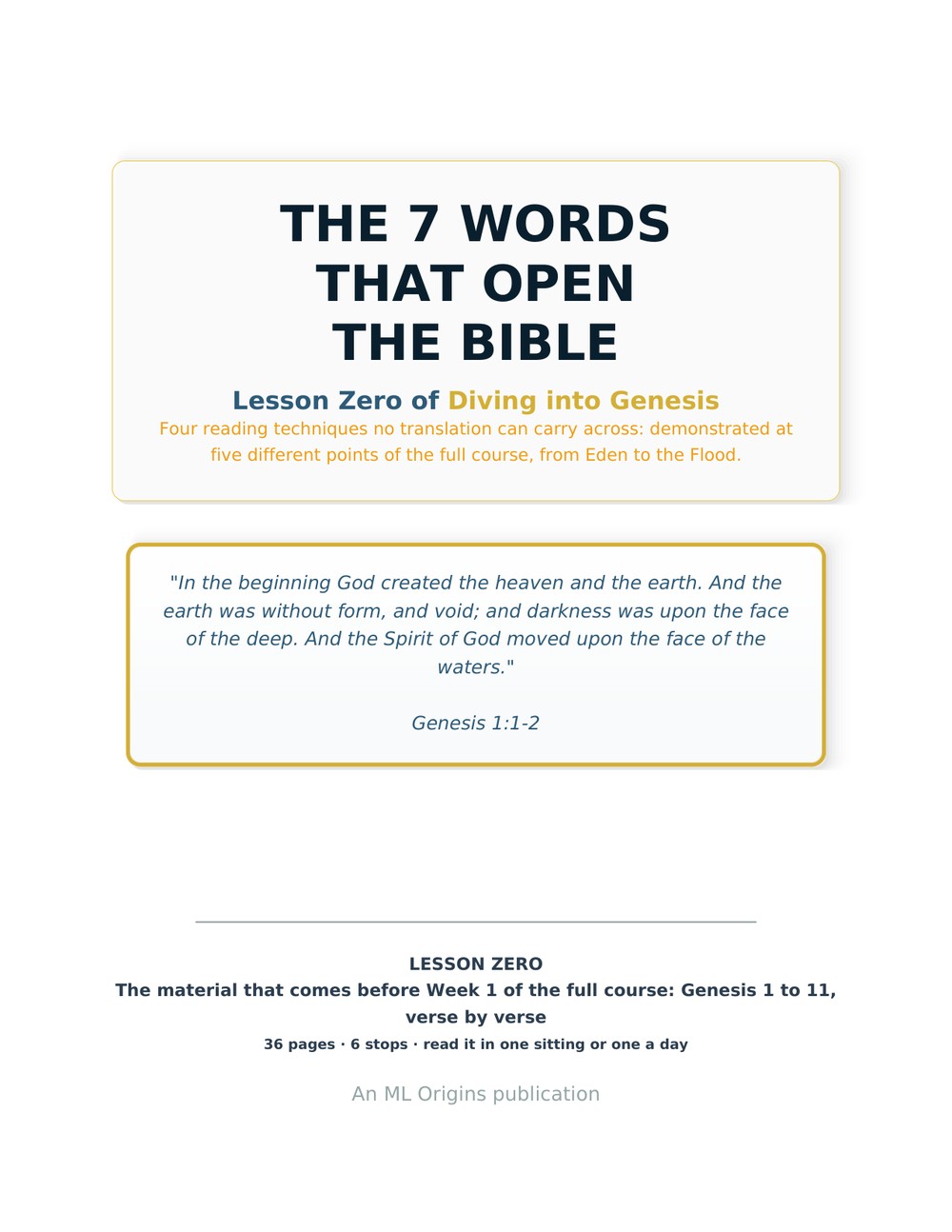 Open Lesson Zero →
Before you ask
Frequently asked questions
How is this different from Lesson Zero?
Lesson Zero teaches the four techniques at five points in the course, as a sample. Mergulho em Gênesis applies the four techniques to each of the eleven chapters, week after week, start to finish — it's the whole journey, not the hook.
Do I need to have done Lesson Zero first?
It's not required, but it helps: Lesson Zero explains the four techniques slowly, across five points of the course. Here they already move at course pace. If you've never done Lesson Zero, Week 1 covers the same ground before moving on to the rest.
Do I need to know Hebrew?
No. Every term appears transliterated, with an explanation in your language — the whole point of the course is to give you access to what Hebrew carries without requiring you to study Hebrew.
Is it a PDF, or are there video lessons?
A study PDF, all twelve weeks. Laid out to print, annotate or use straight on screen — made to be reread, not watched once.
How much time does it take per week?
Each lesson was designed for a thirty-to-forty-five-minute session, plus the seven-day challenge at your own pace. You can read it all at once too — the material doesn't impose a pace, it just suggests one.
Is it for a small group, or just individual?
Both. The reflection questions and the seven-day challenge work as a meeting outline — several people doing the same course, each on their own PDF, with the same material sustaining the group conversation.
Does access expire?
No. You download the twelve PDFs and they're yours, no subscription and no time limit. [FILL IN IF DIFFERENT: if the chosen payment platform limits access to a period, adjust this answer to reflect that accurately.]
Is there a refund?
Yes — seven calendar days from purchase, no need to justify why. See the "Guarantee" section above, and the Terms of Use for the full text.
"In the beginning God created the heavens and the earth." — and there are still ten whole chapters waiting for the same question.
Twelve weeks. One whole book. Once.
You have already seen the method work. Now decide if the full twelve weeks are worth it.